I Spent $8,240 and Eleven Years Treating My Toenails — Then I Found Out Every Product I’d Bought Stops Half a Millimetre Short
Not one of them was designed to reach the thing causing it. Here’s what’s actually under there, why the pharmacy aisle can’t touch it, and the one route in that isn’t through the top of the nail.


My niece’s wedding. Everyone barefoot in the sand. I wore trainers and socks.
I’m about to cost the nail care aisle a customer of eleven years, and I’m going to enjoy it.
That photo is from my niece’s wedding. Late August, 94 degrees, a stretch of beach outside Destin, Florida.
I’d flown down from Ohio for it. Forty people carried their shoes down to the sand. I stood in orthopaedic trainers and thick white socks in ninety-four degree heat and pretended not to notice.
My sister leaned over and said, “Are your feet bothering you, hon?”
“A little,” I said.
That was a lie, and it was easier than the truth.
The truth was that eleven years earlier I’d noticed a small yellow patch on one big toenail. By year three that nail was too thick for regular clippers. By year six it had crossed to the toe beside it. It crumbled when I filed it, and there was debris underneath that never came out no matter how hard I scrubbed.
After eleven years of painting it.
After four laser appointments I paid for out of my own savings.
After three weeks of pills that made me nauseous and a bloodwork schedule I never wanted.
After a drawer of tea tree oil and vinegar and every home remedy the internet swears by.
Not one of them ever touched it. And I finally know why.
I owned a pair of sandals for eleven years that I never once wore outside my own house. They’re still in the box. The tag is still on them.

Here’s what those eleven years actually cost me — and I kept the receipts, because at some point I started keeping them out of spite:
And at the end of it, the nail was worse than when I started.
Not the same. Worse. Thicker, and now on two toes instead of one.
For a long time I assumed that was my fault. That I’d been inconsistent, or hadn’t filed it down enough first, or picked the wrong products.
It wasn’t. And once I understood why, I was genuinely angry.
The Topical-First Playbook
Every product I bought had one thing in common. Every single one was designed to be applied to the top of the nail.
And once you see the sequence, you can’t unsee it:
The Sequence
- You start with the drugstore cream. Cheap, available, and it does nothing, because the nail plate is waterproof.
- So you escalate to the prescription lacquer. $400, and the pharmacist tells you up front it takes twelve to eighteen months — which conveniently means you can’t call it a failure for over a year.
- When that stalls, you’re offered laser. Four sessions, thousands of dollars, and a few weeks of looking slightly better before it returns.
- Then the oral pills, with liver monitoring, which a lot of people over 55 quite reasonably refuse.
- And when you refuse or quit, you’re told it’s chronic, it’s your age, it’s your circulation — and sent home to keep buying lacquer.
Every step is more expensive than the last. Not one of them changes the direction of attack.
I don’t think there’s a room where people plan this. It’s simpler and worse than that: an entire category got built on the assumption that the problem is on the surface — and nobody has any commercial reason to go back and check.
Because a nail that never clears isn’t a failed customer. It’s a subscriber.
Eleven years of lacquer at $400 a bottle is a better business than one thing that works. That’s not a conspiracy. That’s just what happens when nobody checks the assumption underneath the whole aisle.
First — Is This Actually What You Have?
Not every discoloured nail is this. But if you’re nodding at four or more of these, you’re in the same place I was:
- 1 A nail that’s gone yellow, brown or chalky white — and keeps spreading rather than staying put
- 2 Thickening bad enough that ordinary clippers won’t close on it anymore
- 3 The nail crumbling or flaking at the edge when you try to trim it
- 4 Debris packed underneath that never comes out no matter how you scrub
- 5 The nail lifting away from the bed, or separating at the tip
- 6 It jumped from one toe to the next — and now it’s on three
- 7 You’ve tried at least two products that promised results and delivered none
- 8 Closed shoes in July, and quietly declining anything involving bare feet
I checked all eight. My doctor said age and circulation, and told me to keep using the lacquer.
He wasn’t wrong about circulation. He just didn’t tell me the other half.
Three Things Are Happening Under That Nail Right Now
Here’s the reframe that cost me eleven years:
This is not a stain on top of your nail. It is a colony living underneath it, behind a barrier built specifically to keep your treatments out.
Those are not the same problem, and they do not have the same solution. One of them you can scrub. The other one you cannot reach.
Think of it like trying to wash a car that’s under a tarp. You can buy better soap every year for a decade. You will get a very clean tarp.
The organisms responsible don’t live on your nail. They live in the nail bed underneath the hard plate. And they’re doing three separate jobs at once.
The Shield
They secrete a slime-like matrix that hardens into a waterproof layer, cemented between the nail plate and the nail bed. Researchers call it a biofilm. Its entire function is to keep things out.
Research on fungal biofilms has found that organisms sheltered inside one can withstand antifungal compounds at concentrations far above what handles the same organism growing in an open dish. The compound isn’t weak. It never arrives.
The Keratin Feast
They don’t just shelter there. They eat — and what they eat is keratin, the exact protein your nail is built from.
That thickness, the yellowing, the crumbling, the packed debris underneath? None of that is staining. It’s what gets left behind as the nail is consumed from below.
The Circulation Drought
This is the one my doctor half-mentioned, and it matters most past 50.
Your toes are the furthest tissue in your body from your heart, and micro-circulation to the extremities declines with age. The white blood cells that should be handling this aren’t arriving in the numbers they’d arrive anywhere else.
So the shield holds. And no reinforcements are coming.
Now look at what that means for a cream.
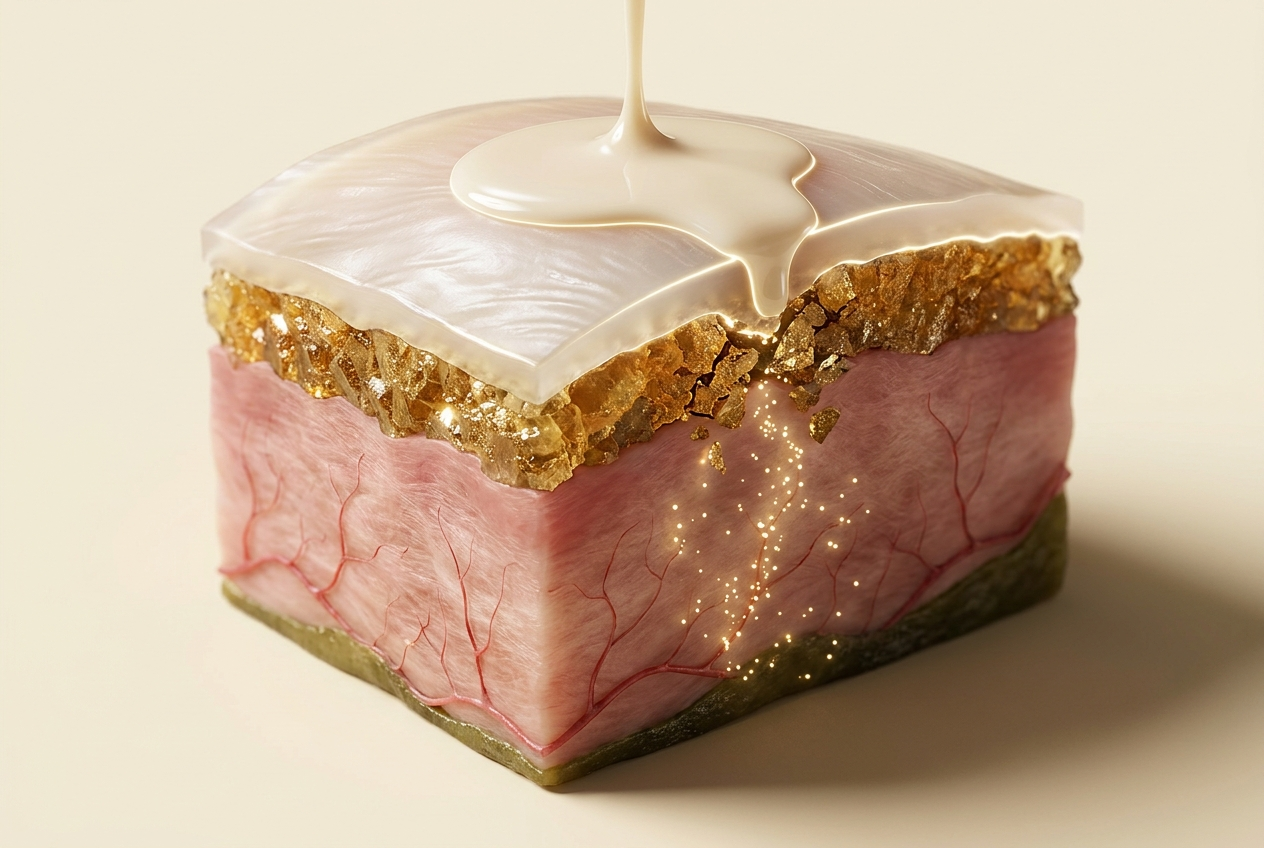
The cream spreads across the plate and stops. What you’re trying to reach is the layer underneath it.
That gap is about half a millimetre. It might as well be a mile.
Which Is Exactly Why Each One Failed
Not one of these was a bad product. Every one was aimed at the wrong side of a waterproof barrier:
- Prescription lacquer — painted onto the plate. Fourteen months of it. The layer underneath never registered a thing.
- Laser — a one-time event, then months of unprotected regrowth while the matrix quietly rebuilt.
- Tea tree oil and vinegar soaks — applied to the surface of something waterproof. Wrecked the skin around the nail, left the nail untouched.
- Filing it down — removed the evidence, never touched the cause. It grew back exactly the same.
- Everything I quit — and this is the cruel one. The matrix starts rebuilding within days of the pressure coming off. Stopping doesn’t pause it. It resets it.
That last point is worth sitting with, because it’s why completed treatments fail too. A finished laser package or a finished course of pills is still an event with an end date. The organism doesn’t have one.
There’s Only One Route In That Doesn’t Go Through the Nail
Once I accepted that nothing applied to the surface would ever cross the plate, the question stopped being which product.
It became: what reaches the nail bed from the other side?
The bloodstream. It’s the only door that isn’t locked.
The nail bed is fed from below. Anything travelling in your blood arrives there without ever having to negotiate with the plate or the shield above it.
So I wrote down what I was actually looking for. Not a brand — a specification. If it couldn’t do all four of these, I wasn’t interested:
What it had to do
- Travel in the bloodstream — so it reaches the nail bed from underneath instead of stopping at a waterproof plate.
- Act on the matrix itself — not just on organisms already exposed, which is the easy half nobody has trouble with.
- Support circulation to the extremities — because breaking a shield achieves nothing if my own defenses still can’t get to my toes.
- Be something I’d actually take every night for a year — no liver monitoring, no filing ritual, no thirty-minute soak.
Four requirements. Most things I found managed one, maybe two.
One compound kept coming back on all four counts — thymoquinone, or TQ, the main active constituent of black seed oil (Nigella sativa).
In the biofilm research it acts on the protective matrix itself rather than bouncing off it. Separately, it’s studied for anti-inflammatory and healthy-circulation support.* And it comes in a soft gel you swallow before bed, which handled the fourth thing on my list without me having to negotiate with myself about it every night.
So I bought black seed oil. And for two months, nothing happened.
Here’s Why — and It’s the Most Important Thing on This Page
Thymoquinone content in black seed oil is not standardized. It varies enormously, and the variation has nothing to do with the brand on the label.
It’s about where the seed was grown.
Most black seed oil on the shelf runs 0.5% to 1.2% TQ. At that concentration you have bought a mild antioxidant supplement and paid full price for it. That was my first two months.
Standard black seed oil
0.5–1.2% TQ
Egyptian, Indian, Turkish sources
Barely enough to matter
Ethiopian Highland black seed oil
5% TQ
Grown above 8,000 ft — Sabel Life
Clinical concentration
Thymoquinone concentration — standardized to active compound percentage

Same plant. Same species. The altitude does the work.
The concentration that actually matters is 5% thymoquinone, and there’s effectively one place on earth where black seed reaches it naturally: the Ethiopian Highlands, above 8,000 feet. Thin air, hard sun, cold nights, wide swings. A genuinely stressful place to be a plant — so the seed concentrates its defensive compounds far past what the same species produces at low altitude.
You cannot manufacture your way there. No amount of processing turns low-altitude seed into highland seed. It’s grown, or it isn’t.
And Here’s How You Check Whether Any of That Is True
This is the part I’d skip past if I were you, so let me be blunt about why it matters.
“5% thymoquinone” printed on a label is a claim. Anyone can print it. The entire argument on this page collapses if the number isn’t real — which is exactly why the only thing worth caring about is whether an independent lab measured it.
Sabel assays every batch through a third-party lab and will show you the certificate. Not a founder’s word. Not a stock photo of a beaker. A dated document with a number on it, for the batch in the bottle you were sent.
If a black seed oil company can’t show you that, you don’t know what you bought.
That’s not a Sabel-specific standard. Apply it to anything you consider, including this. I bought two months of a bottle that never told me its number, and the number was the whole problem.
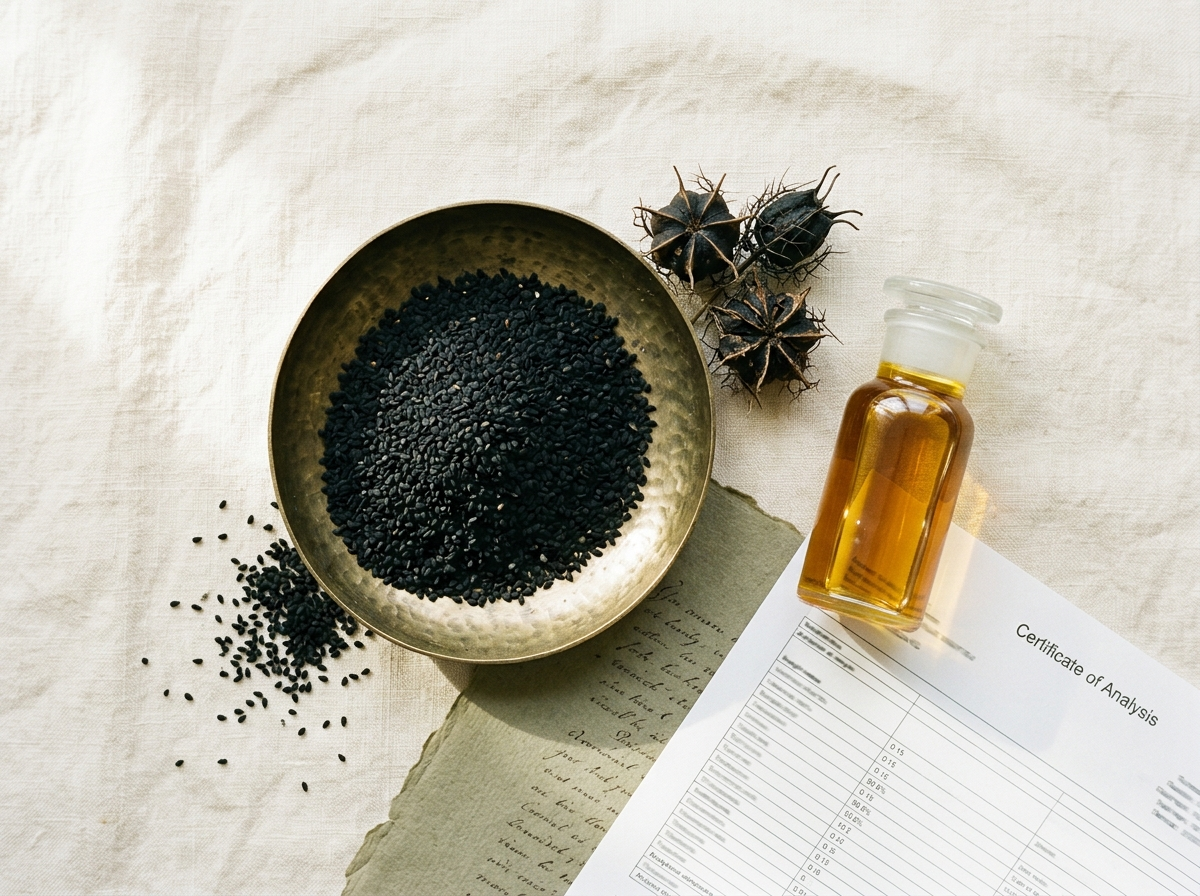
The seed is three thousand years old. The certificate of analysis is what makes the number a fact instead of a claim.
The One I Finally Tried
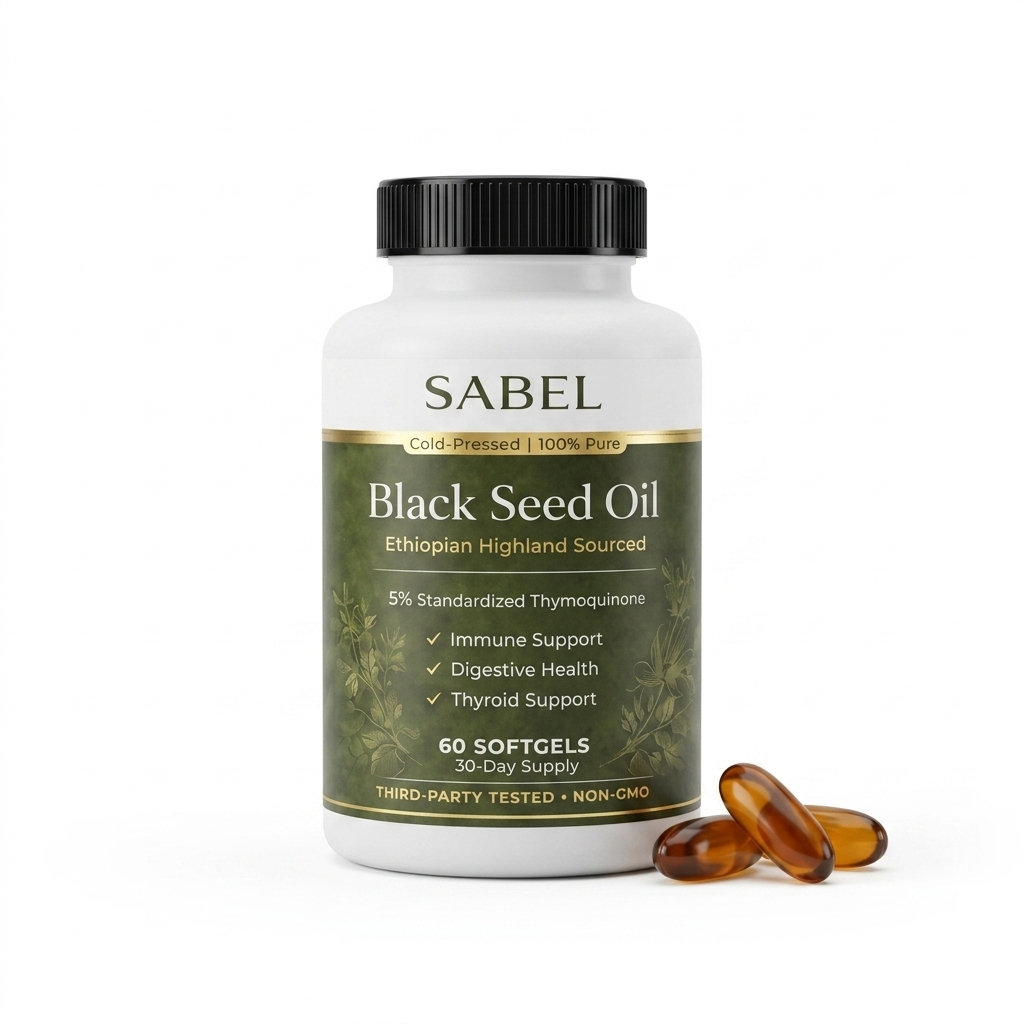
I found a company called Sabel Life doing the one thing nobody else was — sourcing exclusively from the Ethiopian Highlands and standardizing every batch to the full 5% TQ.
I almost didn’t order. After $8,240 I was past optimistic. But it was $39.99 with a money-back guarantee, which after four laser sessions felt like a rounding error.
- Standardized to 5% thymoquinone — up to 10x standard black seed oil
- Ethiopian Highland sourced — 8,000+ feet elevation
- Third-party tested every batch to guarantee potency
- Nothing to paint, soak or file — no mess, no smell
- Two soft gels before bed — that’s the entire protocol
 TRY SABEL LIFE RISK-FREE FOR 30 DAYS
Buy 2 Get 1 Free · Buy 3 Get 2 Free · 30-day money-back guarantee
Now the Part Everyone Else Lies About
I’m going to tell you something that costs this page sales, because it’s the reason I stuck with it when nothing else had held my attention past week six.
Nails are slow. Brutally slow.
A toenail replaces itself over roughly nine to twelve months, and the big toe is slowest of all. Anything promising you a clear nail in two weeks is describing something biologically impossible — and now you know enough to spot it.
So you don’t watch the tip. The tip is old growth and it will never change. You watch the cuticle.
This is the thing to look for, and once somebody draws it for you it’s impossible to unsee. Two different nails on one toe, with a line between them:
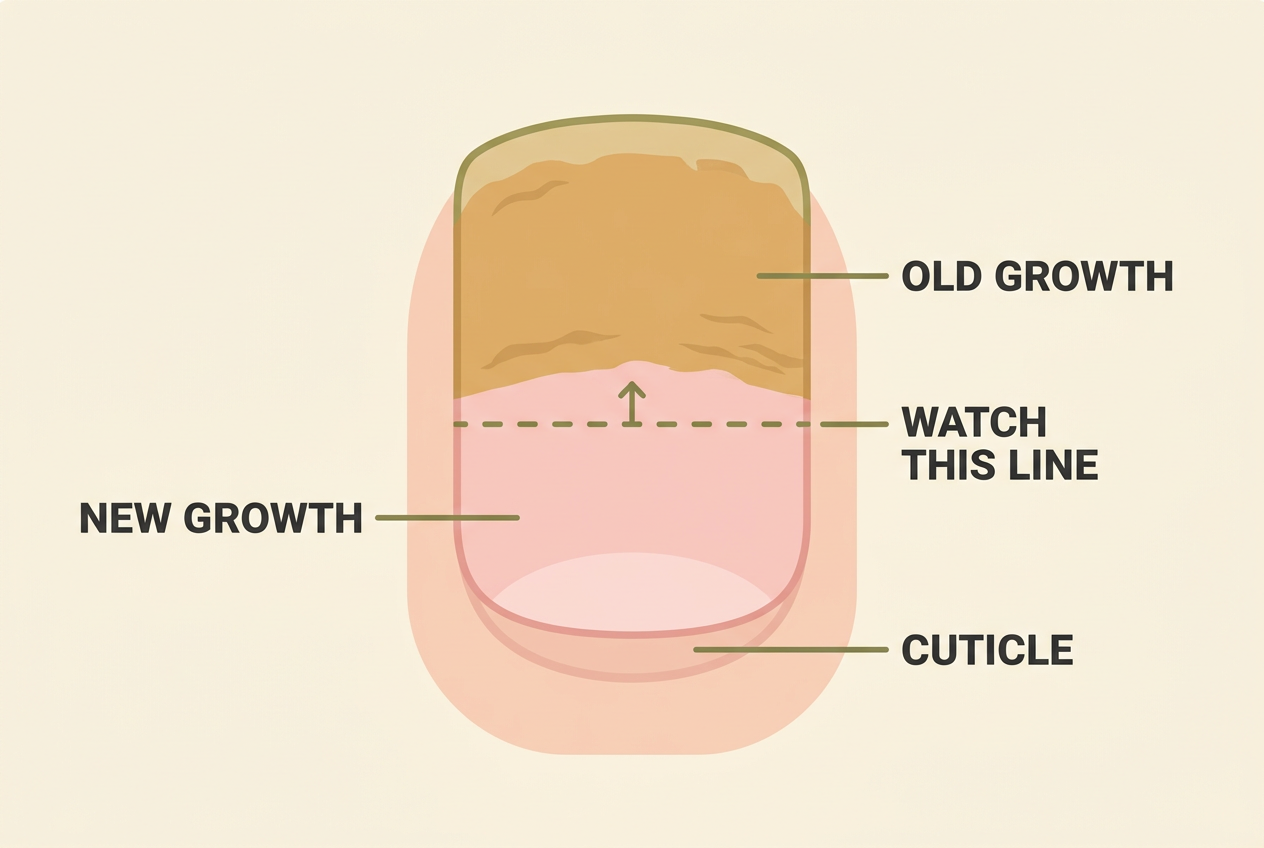
Illustration. The line is the whole story — every month it should sit a little further up the nail.
Nobody told me to watch for that. I spent years checking the tip of my nail, which is old growth and was never going to change, and concluding nothing was happening.
Which is exactly why I’d tell you not to order one bottle.
One bottle is thirty days. Thirty days ends in the middle of the Arrival phase — the one stage where by definition you cannot see anything yet.
If you order one bottle, you will almost certainly conclude it didn’t work, for the same reason I concluded four other things didn’t work. You’ll be judging a nine-month process on a thirty-day sample.
Buy 2 Get 1 Free is three months — enough to reach the cuticle band and actually see something. Buy 3 Get 2 Free is five months, which is the honest minimum for a big toe.
I’m not telling you that to sell you more. I’m telling you because the alternative is you spend $39.99, see nothing on day 30, and go back to the lacquer for another decade.
$8,240 vs $1.34 a day
Eleven years of the Topical-First Playbook against two soft gels before bed. I’m not going to pretend that math was difficult.
Buy 2 Get 1 Free · Buy 3 Get 2 Free · 30-day money-back guarantee
Why It Came Back Every Single Time Before
Every treatment I ever finished, I finished. That was the problem.
The spores live in the keratin. They don’t get evicted, they don’t get sterilised out, and they are not an army you defeat once. They’re residents. And within days of the pressure coming off, the matrix starts going back up.
That’s the actual reason a finished laser package fails at month four. It’s the reason a completed course of pills has a recurrence problem. Neither one failed while it was happening. They failed after — because they were events with an end date, and the organism doesn’t have one.
Nobody takes blood pressure medication for ninety days, sees good numbers, and concludes they’re cured.
The numbers are good because of the medication. Stop, and they climb back. Nobody finds that outrageous. It’s just how managing a chronic variable works.
This is the same, and honestly it’s the part I wish someone had said to me in year one instead of year eleven. Two soft gels before bed keeps the shield down. It takes four seconds. I keep mine next to the toothbrush so it doesn’t depend on me remembering.
I’m Not the Only One Who Was Never Told This
After I wrote about this, my inbox filled up. Not with strangers — with people I’d known for years who’d been hiding the exact same thing.
Since then I’ve heard from a retired teacher who stopped wearing sandals to summer school because she was sure her students could see it from the front row.
A man who hadn’t been in a pool with his grandchildren in four years.
A woman in her forties who’d been quoted $2,400 for laser and was sleeping in socks so her husband wouldn’t see.
A retired nurse who refused the pills for a decade on principle and assumed that meant she had no options at all.
Every. Single. One. Was doing the same thing I was.
Treating the top of the nail — and blaming themselves when it didn’t work.
It was never a discipline problem. It was a direction problem. And once somebody says that out loud, you can’t go back to the aisle.
What I’d Have Asked Before Ordering
I’ve been burned before. Why is this any different?
Mechanically, one reason: direction. Everything you’ve tried was applied to the top of a waterproof plate. This is taken internally and arrives at the nail bed from underneath. Whether that matters to you is your call — but it is a genuinely different route, not a different brand of the same route.
If this is real, why hasn’t my doctor mentioned it?
Two honest reasons. First, this is a supplement, not a prescription — it isn’t in the treatment pathway a podiatrist is trained to work through, and nobody sends a rep to their office about it. Second, the concentration point is genuinely obscure: most clinicians who know black seed oil know it as the commodity 1% version, which honestly doesn’t do much. They’re not wrong about that bottle. They’ve just never had reason to ask where the seed was grown.
Isn’t black seed oil just another supplement?
Most of it, honestly, yes — at 0.5–1.2% TQ you’re buying a mild antioxidant. That was my first two months and it did nothing. The entire argument here rests on concentration and origin, which is why the third-party assay on every batch matters more than any claim on the label.
Why is the guarantee only 30 days if it takes months?
Fair, and I asked the same thing. Thirty days isn’t long enough to judge your nail — it’s long enough to judge the product and the company. Whether it arrives, whether the assay is real, whether you can swallow two soft gels a night without thinking about it. If any of that is wrong for you, you get your money back. The nail question is answered at month three, which is why I’d order three months.
Do I have to take it forever?
Not forever — but longer than you want to hear. The spores live in the keratin; they don’t get evicted, and the matrix starts rebuilding within days of the pressure coming off. That’s precisely why finished laser packages and completed pill courses so often end with the yellow creeping back. Nobody stops blood pressure medication at ninety days because the numbers improved.
I’m on other medication.
Then talk to your doctor or pharmacist first. I did. It’s a cold-pressed seed oil in a soft gel rather than a drug, but that is not a reason to skip the conversation, and anyone telling you otherwise is not looking out for you.
The Cuticle Test — 30 days, on us
Before your first soft gel, take one photograph. Straight down at the base of the worst nail, in daylight, next to something for scale. Date it.
Take the same photo, same angle, every thirty days. That’s the whole test — because nail change is far too slow to judge from memory, and you will absolutely talk yourself out of real progress without a reference shot. I did it twice.
If at any point in the first 30 days you decide this isn’t for you, email us and we’ll refund you. No forms, no interrogation, no restocking anything.
It Was Never About the Nail
I want to be accurate about what changed, because it isn’t what I expected.
I thought I wanted a clear toenail. That’s what I’d have said for eleven years if you’d asked me.
What I actually wanted was to stop calculating.
Because that’s the real cost, and nobody warns you about it. It’s not the nail. It’s the running arithmetic underneath every ordinary invitation.
Somebody says we’re going to the lake Saturday and there’s a half-second where you work out whether that means bare feet, and whether you can get away with the excuse you used in June, and whether your sister is going to ask about your feet again in front of people.
You get very good at it. That’s the part that got me — realising how practised I was.
The change wasn’t the day my nail looked different. It was the day someone said “pool’s open” and I didn’t do the maths.
Now: I keep sandals by the door instead of in a box. I got a pedicure in April and didn’t rehearse a single sentence on the drive over. When my granddaughter asks me to come in the water, the answer is just yes, immediately, the way it’s supposed to be.
That’s what eleven years of lacquer was actually costing me. Not a nail. Every automatic yes I’d quietly turned into a decision.
You’ve Got Two Versions of Next Summer
Stay on the Playbook
- Another tube, another lacquer, another thing applied to the roof
- Another appointment that buys six weeks of slightly-less-yellow
- The matrix thickens, so it takes longer to reach next year than it would now
- It spreads — one nail becomes three
- Another August in closed shoes, and the sandals stay in the box
Change the Direction
- Two soft gels before bed — nothing to paint, soak or file
- 5% TQ, taken internally, arriving from underneath
- Circulation support so your own defenses can finally get there
- A photograph at the cuticle every 30 days, so you actually know
- $1.34 a day, and 30 days to decide it was worth it
Exactly What Happens Next
Pick a real run, not a sample
Buy 2 Get 1 Free — three bottles, three months. Enough to reach the cuticle band and actually see something.
Buy 3 Get 2 Free — five bottles, five months. The honest length for a big toe, and the one I’d pick again.
One bottle ends before anything is visible. I wouldn’t start there.
It ships within one business day
Most orders land in a few days. Nothing to assemble, nothing to mix, no appointment.
Take your day-one photo before the first dose
Straight down, daylight, something for scale. This is the single highest-value thing you will do, and it takes ten seconds.
Two soft gels, before bed, every night
Not one. Not “when you remember.” Four seconds, next to the toothbrush so you don’t have to rely on willpower.
Watch the cuticle, ignore the tip
The tip is old growth and will never change. Everything that matters happens at the base.
Don’t stop when it starts working
This is the one that undoes people. Clear growth means the shield is staying down — because you’re keeping it down.
The Shield Doesn’t Hold Still While You Decide
- The matrix thickens — so it takes longer to reach a year from now than it would today
- It spreads toe to toe — one nail becomes three, becomes seven
- The nail matrix at the base can be permanently damaged — and that’s the part that decides what grows back at all
- Another summer becomes another year — that’s how I lost eleven of them
And I know exactly how this goes, because I did it for eleven years. You don’t decide against it. You decide to deal with it later.
“Later” is another August in closed shoes.
“Later” is another pair of sandals that stays in the box with the tag on.
“Later” is standing on a beach in trainers while your family carries their shoes down to the water.
“Later” isn’t a decision. It’s just how you spend the summers while you’re making one.
I used to imagine kicking my shoes off at the lake without thinking about it. Not deciding to — just doing it, the way everyone else does.
I don’t have to imagine that anymore. That was last month.
Eleven Years. $8,240. One Wrong Assumption.
That the problem was on the surface. It never was.
Sabel Life Ethiopian Black Seed Oil — Highland sourced, standardized to 5% thymoquinone, third-party tested, two soft gels before bed. Backed by a 30-day money-back guarantee.
Individual results may vary.
Bottled in small batches from a single Ethiopian Highland harvest. When a batch sells through, the next one waits on the growing season — not on a marketing calendar.
TRY SABEL LIFE RISK-FREE FOR 30 DAYSBuy 2 Get 1 Free · Buy 3 Get 2 Free · 30-day money-back guarantee
To the eleven years I’m not getting back,
Karen D.
Ohio · Eleven years, $8,240, and one wrong assumption
Wearer of sandals, as of this summer
P.S. — If you take one thing from all of this, take the direction. It was never that you were inconsistent or bought the wrong brand. Every product in that aisle is engineered for the top of a waterproof plate, and the thing you’re trying to reach is underneath it. That’s not a personal failure. That’s a category-wide wrong assumption you happened to be standing under.
P.P.S. — Please don’t order one bottle. I know how that reads coming from a page trying to sell you something. But thirty days ends before anything is visible, and I would rather you order nothing than order once, see nothing on day 30, and spend another decade convinced this doesn’t work either.
P.P.P.S. — Take the day-one photo. Ten seconds, straight down, in daylight. Every single person I know who lost faith in this lost it because they were comparing today’s nail to a memory, and memory is useless at this timescale. The photo is the difference between knowing and guessing.
P.P.P.P.S. — The sandals are out of the box. Eleven years, and it turns out the whole thing came down to which side of the nail you were working on.
Buy 2 Get 1 Free · Buy 3 Get 2 Free · 30-day money-back guarantee
*These statements have not been evaluated by the Food and Drug Administration. This product is not intended to diagnose, treat, cure, or prevent any disease. Sabel Life is a dietary supplement, not a medication. Individual results vary and the experiences described are not typical.
This page is an advertisement and is not medical advice. Nail discoloration and thickening have causes other than fungal infection, including trauma, psoriasis and circulatory conditions — a qualified healthcare provider should make any diagnosis. If you have diabetes, peripheral circulatory problems, or a compromised immune system, do not self-treat a foot or nail condition — consult your provider. Speak with your doctor or pharmacist before beginning any supplement, particularly if you are pregnant, nursing, or taking prescription medication. Costs described reflect one individual’s reported spending and are not typical or representative.
© 2026 Sabel Life. All rights reserved.